
|
Explainer · last look 16 September 2026 Air vs sea for a UK box — when the premium is worth it Most of what Britain buys does not fly. By weight, 86% of UK international freight comes by sea. Air is under 1% of the tonnes and about a third of the value. The flight from Shanghai to Heathrow is half a day. The ticket is not. Fly the part that stops a factory. Sail the sofa. The test is simple: would one week of empty shelf cost more than the air premium? |
If you remember one sentence: fly the part that stops the line. Sail the sofa.
How fast is each road, really?
|
Hours The flight. PVG or CAN to LHR is 12–15 hours. That is not the clock you buy. |
5–12 days Air, door to door. Pickup, export, security, flight, Heathrow, HMRC, the van. Express can be 3–6. |
Weeks Sea. Port to port 30–47 days on today’s Cape habit. Door to door often 38–55. That is the Christmas cut-off story. |
A 14-year-old version: the school bus is cheap and slow. A taxi is dear and quick. You do not taxi the PE kit for next term. You taxi the exam paper due Friday.
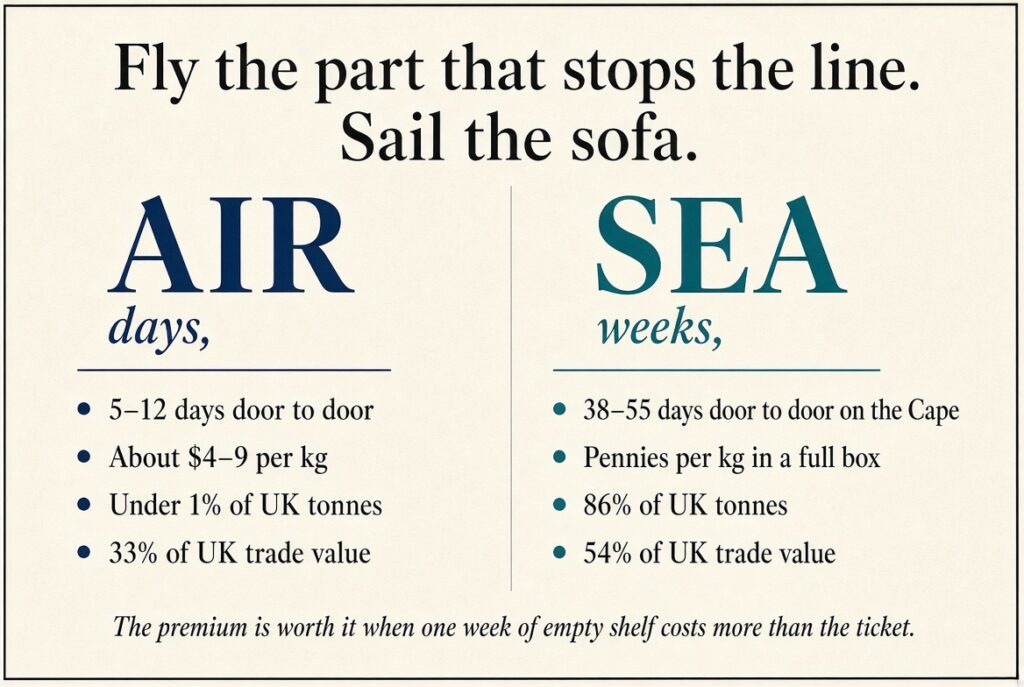
The official split — weight versus value
| UK international freight, 2024 | By weight | By value |
|---|---|---|
| Sea | 86% | 54% |
| Air | under 1% | 33% |
| Pipes and fixed kit | 9% | 2% |
| Tunnel / rail mix | ~3% | ~11% |
Source: DfT, Transport Statistics Great Britain 2024 (published December 2025), HMRC trade analysis. CAA: UK airports handled about 2.66 million tonnes of air cargo in 2025; Heathrow about 1.55 million. Sea containers alone were about 61 million tonnes in 2024. Air is a thin pipe with expensive water.
| 86% sea, by tonnes |
<1% air, by tonnes |
33% air, by value |
~25× sea boxes vs air tonnes |
What the ticket looks like in 2026
Rates move weekly. Treat these as a planning band, not a quote. Ask for all-in.
| Mode, China → UK | Typical 2026 band | Door to door |
|---|---|---|
| 40ft sea box (FCL) | About $2,800–$4,600 ocean | 38–50 days |
| LCL (shared box) | About $45–$90 per cubic metre, plus minimums | 42–55 days |
| Standard air | $4–$9 per chargeable kg | 8–12 days |
| Express courier | $8–$15 per kg | 3–6 days |
Air is billed on chargeable weight: the greater of kilos on the scale and kilos implied by the box (cm length × width × height ÷ 5,000). Pillows look light and pay like bricks. Phones look small and pay like phones.
Two worked tickets
| Cargo | Sea | Air | Verdict |
|---|---|---|---|
| 300 kg electronics, 1.5 m³ | LCL ~$300–$450 freight. 6–8 weeks door to door. | ~$1,800 at $6/kg. 8–12 days. | Air if the shelf dies this month. Sea if it can wait. |
| A sofa / bulky home goods | Pennies per kilo in a 40ft. | Volumetric weight explodes. Thousands for cushions. | Sail it. Always. |
A factory line that stops for a £40 sensor can justify a £400 air ticket. A sofa that arrives in November instead of October cannot. That is not poetry. That is contribution margin versus freight.
The one-week test
| 1 · Price the air premium — air ticket minus the sea ticket for the same kilos. |
| ↓ |
| 2 · Price one week empty — units you would have sold × margin you would have kept. |
| ↓ |
| 3 · Fly only if 2 is bigger than 1 — or if a line stops, a launch dies, or the sea cut-off has already passed. |
A rough density rule that survives most books: if the goods are worth more than about $20–50 per kilo, air can be a small slice of the invoice. If freight would be more than 10–15% of the goods’ value, sea is the default unless the calendar has already closed.
Who should fly, who should sail
| Fly | Sail |
|---|---|
| The spare that stops a factory | The sofa, the BBQ, the plastic bin |
| A launch SKU with a date on the poster | Steady restock you can see coming |
| Samples and first orders under ~100 kg | Anything that fills a 20ft or 40ft |
| A Christmas SKU that missed the early-October sailing | The rest of the aisle — see Cape parcels |
| Phones, chips, some fashion, medicines | Furniture, tools, pet food, bottled anything |
A hybrid is normal. Most serious importers send 80–90% of weight by sea and keep air for the spike. That is not indecision. That is the official map: sea carries the tonnes, air carries the urgency.
Where the plane actually lands
| Airport | Job |
|---|---|
| Heathrow | The value door. About 1.55 Mt in 2025. CAA: Heathrow alone ~26% of UK trade value. |
| East Midlands | Night cargo and integrators. Parcels and e-commerce. |
| Stansted, Gatwick, Manchester | The rest of the top five. Together with Heathrow, about 31% of trade value. |
The sea door for the same box is still Felixstowe, London Gateway or Southampton. Air does not replace that door. It bypasses the weeks.
What this is not
| Mistake | Why it fails |
|---|---|
| “Air is always two days” | The flight is. The door-to-door is a week-plus unless you pay express. |
| “Sea is 30 days so we still have time in November” | Cape door-to-door is often 38–55. Mid-December shelf needed an October sailing. See Christmas parcels. |
| Flying the whole container because one SKU is late | Split the bill. Fly the late SKU. Sail the rest. |
The short answer
Air is how Britain moves a third of trade value on less than one percent of the tonnes. Sea is how it moves the rest. The premium is worth it when one week of empty shelf, or a stopped line, costs more than the ticket. It is not worth it for the sofa. Name the SKU. Price both roads. Then pick.
Cut-off: Christmas parcels / Cape · Door: Felixstowe vs Immingham · Board: are the sea routes into the UK open?
DfT Transport Statistics Great Britain 2024 (Dec 2025): sea 86% of UK international freight by weight and 54% by value; air under 1% by weight and 33% by value. CAA airport statistics: 2.66 million tonnes air cargo at UK reporting airports in 2025; Heathrow 1.55 million; Heathrow ~26% of UK trade value on HMRC analysis. DfT port freight 2024: containers 60.7 million tonnes. Indicative 2026 China–UK bands compiled from forwarder guides current in 2026 (ocean 40ft $2,800–$4,600; air $4–$9/kg; door-to-door air 8–12 days, sea 38–55 on the Cape habit). Chargeable weight: IATA volumetric ÷ 5,000. Not a quote. Not a booking. Passage Brief records the passage between the headline and the British till.