
|
Explainer · last look 16 September 2026 Why can a UK gas bill still feel Hormuz? Oil is the tanker you can see. Gas is the cargo that uses the same pinch — then a different pipe. Two things happened to Qatar in 2026. Iranian missiles hit Ras Laffan on 18–19 March and knocked out two of fourteen LNG trains — about 17% of Qatar’s export kit — for three to five years. Hormuz then bottled most of what was left. Britain barely burns that molecule. It still pays the world price. The North Sea and Norway fill the meter. TTF and NBP set the ticket. |
If you remember one sentence: about 1% of UK gas in 2025 was Qatari. The world lost a fifth of its LNG tap behind Hormuz, and 12.8 million tonnes a year of Qatari kit for years. The bill moved because the pool moved.
How quickly does a Gulf gas shock reach a British kitchen?
|
Same day Wholesale. TTF in the Netherlands and NBP in Britain jump when traders price a thinner world LNG pool. No Qatari tanker has to dock at Milford Haven first. |
Weeks US and other Atlantic cargoes get bid away. Europe and Asia fight for the same spare ships. Storage and interconnectors do the quiet work. |
A quarter The Ofgem cap. It is not live. It is a delayed photograph of wholesale. October 2026 is the next print. |
A 14-year-old version: imagine the school canteen buys chips from one big world warehouse. Britain grows some potatoes and buys most of the rest from Norway. Qatar is a small crate in that warehouse. If Qatar’s crate is stuck behind a locked gate, the warehouse price still goes up. Britain did not lose its lunch. It paid more for the same lunch.
What does Britain actually burn?
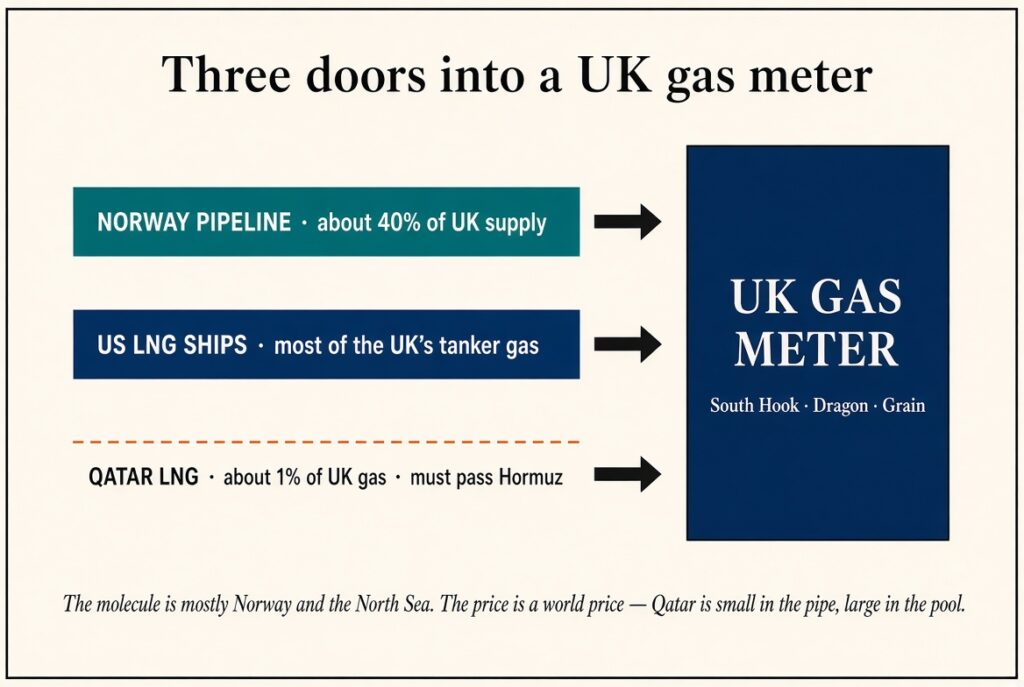
Do not start with Qatar. Start with the pipe. DUKES 2025 is the official cake.
| Norway 69% of imports ~40% of gross supply |
US LNG 76% of LNG ~13% of gross supply |
UKCS home North Sea still falling |
Qatar ~1% |
Shares of the 2025 picture. Norway is the fat slice. Qatar is the thin orange edge. Source: DUKES chapter 4 / GOV.UK Iran energy factsheet, March 2026.
| Line, 2025 | Official figure | Source |
|---|---|---|
| UK gas production | Down 3.4% on 2024. Lowest since 1973 | DUKES 2025 ch.4 |
| Norway share of UK gas imports | 69% (was 76% in 2024). ~40% of gross supply | DUKES 2025 ch.4 |
| US share of UK LNG imports | 76%. 13% of gross supply. Up 38% on 2024 | DUKES 2025 ch.4 |
| Qatar share of UK LNG imports | 6.0% of LNG. 1.8% of total imports. ~1% of supply | DUKES; GOV.UK factsheet |
| Algeria LNG | Overtake Qatar as third LNG origin in 2025 | DUKES 2025 ch.4 |
Qatar was once huge here — nearly 40% of all UK gas imports at its 2011 peak, and the top LNG origin until 2022. That crate shrank. The price link did not.
So why does Hormuz still sit inside the bill?
Because gas is one pool with several taps. Lock one big tap and the other taps get more expensive.
| World LNG exporters, 2025 | Million tonnes | Share |
|---|---|---|
| United States | 110.7 | 25% |
| Qatar | 81.5 | 19% |
| Australia | 80.3 | 18% |
| Russia | 30.5 | 7% |
Qatar plus the UAE is about a fifth of world LNG. Almost all of that cargo is born inside the Gulf. The only wet door out is Hormuz. There is no LNG bypass equivalent to the Saudi or UAE crude pipelines. When that door thins, Asia and Europe bid for US and other Atlantic cargoes. Britain’s own LNG is mostly American. Those American cargoes suddenly have more suitors. That is the price, not the molecule.
What was actually hit at Ras Laffan
Two problems. Do not mix them up. One is steel. One is water.
| Constraint | What happened | How long |
|---|---|---|
| The plant | Iranian missiles, 18–19 March 2026. Trains 4 and 6 damaged. 12.8 million tonnes a year. About 17% of Qatar’s LNG export kit. Cryogenic heat exchangers. Pearl GTL also hit. | 3–5 years to repair, QatarEnergy CEO Saad al-Kaabi, 19 March 2026. About $20 billion a year of lost revenue. |
| The door | Hormuz. Almost no regular LNG transit since late February. Force majeure rolled month by month. Edison: 29 cargoes cancelled into early November, about 3.8 billion cubic metres. | Until ships will risk the strait. Mitsui O.S.K., 16 September 2026: LNG through Hormuz “almost impossible.” |
| Ras Laffan clock, 2026 | What the record says |
|---|---|
| Early March | Whole complex halted after a drone strike. Force majeure declared. |
| 18–19 March | Missiles hit Trains 4 and 6 (joint ventures with ExxonMobil). Named buyers: China, South Korea, Italy, Belgium. |
| 10 April | Last pre-war Qatari cargo lands at South Hook, Milford Haven (Kpler). |
| June | Kpler thermal imagery: five trains working. About 35% of nameplate. Jetty 2 unused since the strikes. |
| June–July | Undamaged trains can run. QatarEnergy: 50% of capacity in a month after safe transit, 80% in two — if ships come. Shipping, not stills, is the near-term bind. |
| August | Loadings the strongest since March, still about 60% below the year before. |
| Mid-September | A trickle: one cargo to Pakistan, first known crossing since July. Force majeure still running into November. QatarEnergy shopping US LNG through 2031 to cover the broken trains. |
Shell’s Wael Sawan, mid-September: about 36 million tonnes of Qatari and Emirati supply missing year-to-date against 2025. Reopening the strait does not put Trains 4 and 6 back. Those two trains are the size of a whole ordinary LNG project. They stay out until the cryogenic kit is rebuilt.
A 14-year-old version: the school warehouse had a locked gate and two smashed freezers. Unlocking the gate does not unsmash the freezers. Britain still did not get its chips from that warehouse. It paid more because everyone else was now queueing at the American hatch.
| 1 · Plant and door — Two Ras Laffan trains smashed. Hormuz then bottles most of what can still run. About a fifth of world LNG sat behind that gate in 2025. |
| ↓ |
| 2 · World pool thins — Asia, which took nearly 90% of Qatar’s 2025 exports, hunts replacement cargoes. |
| ↓ |
| 3 · TTF and NBP jump — Europe’s wholesale hubs move the same day. Britain is a price-taker. |
| ↓ |
| 4 · The cap photograph — Ofgem prints the next quarter from that wholesale. The kitchen sees it later. Off-grid oil homes see kerosene first. See heating oil versus diesel. |
What 2026 actually did to the UK ticket
Wholesale gas doubled in early March when the Gulf war opened. It eased in early summer. By late August spot was the highest since January 2023. The cap is the lagging photograph.
| Cap quarter | Typical dual-fuel DD | Gas unit | What moved |
|---|---|---|---|
| Jul–Sep 2026 | £1,663 | 7.33p/kWh | Gas up sharply on Q2. Wholesale from the first Gulf shock. |
| Oct–Dec 2026 | £1,723 | 7.97p/kWh | Gas +8 to +9%. Electricity almost flat. Confirmed 26 Aug. |
Homes that burn no gas see almost none of that October rise. Homes that burn a lot of gas see most of it. Standing charges barely move. The unit is the Hormuz fingerprint.
| Ticket | Cap? | How Hormuz arrives |
|---|---|---|
| Mains gas (GB) | Yes — Ofgem, quarterly | Wholesale first. Cap a quarter later. |
| Electricity (GB) | Yes — same cap | Gas still sets a slice of generation. Weaker fingerprint than the gas unit. |
| Heating oil / kerosene | No cap | Jet wholesale, days to a fortnight. 1.5 million tanks. |
| Northern Ireland gas | Different regulator | Same world pool. Different till. |
Three UK LNG doors — none of them sit on the Gulf
| Terminal | Where | What it is for |
|---|---|---|
| South Hook | Milford Haven | Built around Qatari cargoes. Last pre-war Qatari cargo landed 10 April 2026 (Kpler). |
| Dragon | Milford Haven | Second Haven door. Atlantic and other cargoes. |
| Isle of Grain | Kent | The big east-coast tank. US and other LNG. |
National Gas puts GB import kit at about 368 million cubic metres a day: roughly 135 from Norway, 83 from Belgium and the Netherlands, 150 from LNG. The pipes can take more than a thin Hormuz week. The price is the thing that flexes first.
Gas versus oil versus a late sofa
| Mains gas | Heating oil | Christmas box | |
|---|---|---|---|
| Gate | Hormuz as world LNG price | Hormuz as jet / kerosene | Cape as time |
| UK molecule | Norway + UKCS + US LNG | Imported kerosene | China box via Felixstowe |
| Clock | Same day wholesale · quarter cap | 1–14 days | 3–6 weeks |
| Cap | Ofgem | None | None |
What should a household or a buyer do with this?
| If you | Treat the price as |
|---|---|
| On mains gas, GB cap | October unit is the live photograph of summer wholesale. Budget the winter quarter at the new cap, not last year’s. |
| Off the gas grid | You are on kerosene. No cap. Read heating oil versus diesel. |
| A factory on interruptible gas | Wholesale is live. The cap does not sit on your invoice. |
| Watching Qatar headlines | Ask what TTF did that morning. Do not count Qatari tankers on the Haven. |
The short answer
A UK gas bill can feel Hormuz because Britain is a price-taker in a world LNG pool. Qatar was a fifth of that pool in 2025. In March 2026 two of its fourteen trains were hit — 12.8 million tonnes a year, three to five years out — and the strait bottled the rest. The molecule in the radiator is still mostly Norwegian and home-grown, with US LNG as the swing crate. The ticket is TTF and NBP. The cap is the photograph, one quarter late. Unlocking Hormuz does not unscrew Trains 4 and 6.
The gate in full: Strait of Hormuz · Tank: heating oil versus diesel · Lorry: fuel that moves the lorries · Board: are the sea routes into the UK open?
DUKES 2025 chapter 4: Norway 69% of UK gas imports and ~40% of gross supply; US 76% of LNG and 13% of gross supply; Qatar 6% of LNG and 1.8% of total imports. GOV.UK Iran–UK energy factsheet, 6 March 2026: about 1% of 2025 UK gas from Qatar. IGU World LNG Report 2026: US 110.7 Mt, Qatar 81.5 Mt (19%). QatarEnergy / Saad al-Kaabi, 19 March 2026: Trains 4 and 6 hit 18–19 March; 12.8 mtpa; ~17% of export capacity; 3–5 years; ~$20bn a year; force majeure on China, South Korea, Italy, Belgium. S&P Global Energy, 19 March 2026. Kpler: last pre-war cargo to South Hook 10 April 2026; June thermal imagery five trains, ~35% nameplate. Edison / gasworld, 4 September 2026: force majeure to early November, 29 cargoes, ~3.8 bcm. The National / Shell, 14 September 2026: ~36 Mt Qatari and Emirati supply missing year-to-date. Mitsui O.S.K. at Gastech, 16 September 2026: Hormuz LNG “almost impossible.” Reuters, 11 September 2026: QatarEnergy seeking US LNG cover through 2031. Commons Library CBP-9714, 28 August 2026: wholesale doubled early March; Jul–Sep cap £1,663; Oct–Dec gas unit 7.97p. Not a price forecast.