

On a litre of UK diesel the Treasury takes two taxes: fuel duty at 52.95p, then VAT at 20% on the whole price. Duty is the same on petrol. VAT is the same rate on both. The extra pence of VAT on diesel comes only because the pre-tax litre costs more.
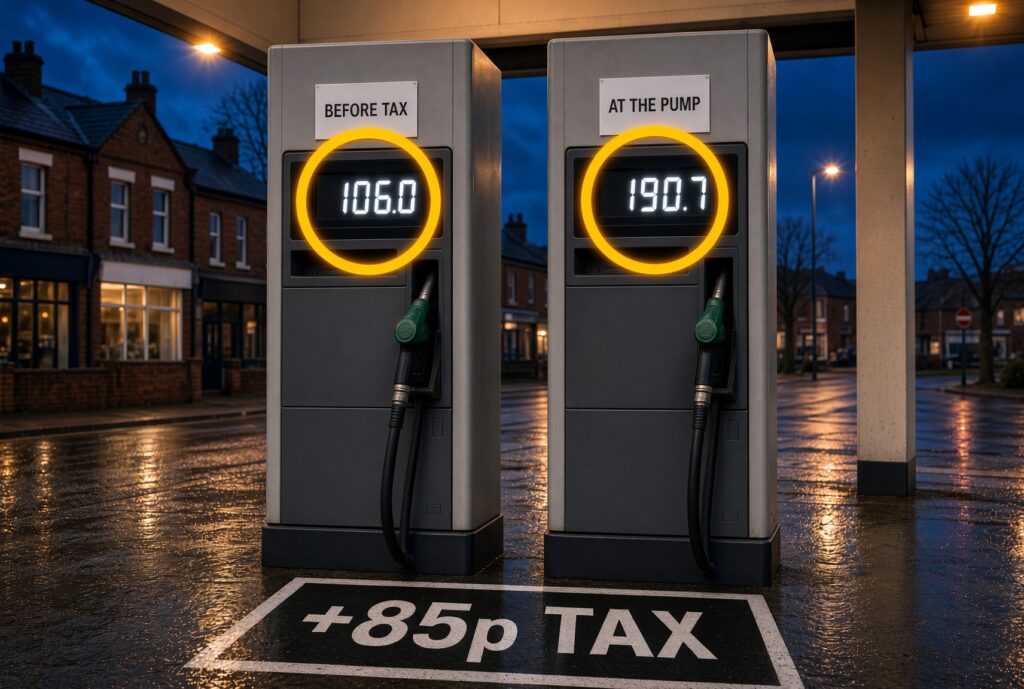
Using the official average for the week commencing 14 September 2026, a litre of diesel cost 190.72p. Of that, 52.95p was duty and 31.79p was VAT, so tax was 84.74p, or 44% of the litre.
| Duty is a stamp 52.95p on every road litre. Same on petrol. |
VAT is a share 20% of the whole ticket, including duty. |
Not a higher rate Diesel pays a few extra pence of VAT because the wholesale litre is dearer. |
Dated box — DESNZ week commencing 14 September 2026. Refresh Table 1 if the pump figure is more than 14 days old.
| What is in one litre | Pence | Share |
|---|---|---|
| Wholesale fuel, delivery, retailer margin | 105.98 | 55.6% |
| Fuel duty | 52.95 | 27.8% |
| VAT at 20% | 31.79 | 16.7% |
| Pump price | 190.72 | 100% |
Table 1. Source: DESNZ weekly road fuel prices, week commencing 14 September 2026. Duty: HMRC 52.95p. VAT: 20% standard rate.
UK road diesel and petrol carry the same fuel duty: 52.95 pence per litre. VAT at 20% is charged on the full pump price, including duty. Diesel is not taxed at a higher rate than petrol. The extra tax in pence is VAT on a dearer wholesale litre.
The question in plain English
When people ask how much of the UK diesel price is tax, they usually mean two simpler questions. How much of this litre is the government? How much is oil?
The government bit is two taxes, not one. Fuel duty is a fixed stamp on each litre. VAT is a share of the whole bill. The oil bit is everything else: the wholesale product, the tanker run, and the retailer margin.
The number on the pump is those parts added together. The pence will move. The two tax rules stay the same unless Parliament changes them. A local pump will not always match the national average. Put any pump number through the same sums. This page uses the official DESNZ weekly average so the split can be checked.
What is fuel duty on diesel?
Fuel duty is a fixed charge in pence per litre. It is not a percentage. It does not rise when oil rises. It does not fall when oil falls.
UK road diesel and petrol carry the same fuel duty: 52.95 pence per litre. That is the HMRC rate on 17 September 2026.
The 52.95p rate includes a 5p cut first applied on 23 March 2022. Before that date the main rate was 57.95p. HMRC has extended the 5p cut to 31 December 2026. The extension is set out in HMRC’s note on amended fuel duty rates for 2026 to 2027, after the government announcement of 20 May 2026.
Duty is the same at a supermarket and on a motorway. The litre on the pump already includes it.
| Fuel | Duty now | Duty before 23 March 2022 |
|---|---|---|
| Diesel (road) | 52.95p | 57.95p |
| Petrol | 52.95p | 57.95p |
Table 2. Source: HMRC, Amended Fuel Duty rates: 2026 to 2027. Current rates apply to 31 December 2026.
Red diesel is the same diesel molecule with a dye and a marker. It is legal only for allowed uses, such as agriculture and some non-road machines. The duty is much lower: 6.48p a litre from 15 June 2026 to 31 December 2026 (HMRC). This page is about white, road diesel. For the legal split, see red versus white diesel.
How does VAT work on diesel?
VAT at 20% is charged on the full pump price, including duty. In the sum, the rate is applied to the net litre: wholesale fuel, plus duty, plus the retailer margin. VAT is then added. That total is the pump price.
A 14-year-old can copy this sum. First method, from the bits before VAT: (wholesale + duty + margin) × 0.20 = VAT. Second method, from the number on the pump: pump price ÷ 1.20 × 0.20 = VAT. The second method is the same as dividing the pump price by six. While the VAT rate is 20%, VAT is always one-sixth of the pump price.
Worked example, week commencing 14 September 2026. DESNZ average diesel: 190.72p. 190.72 ÷ 1.20 = 158.93p (the litre before VAT). 158.93 × 0.20 = 31.79p (VAT). Check: 158.93 + 31.79 = 190.72p. Duty in that 158.93p is 52.95p. The rest, 105.98p, is wholesale fuel, delivery and the retailer margin.
Duty is identical on petrol and diesel. The VAT rate is identical too. Diesel’s wholesale bit is higher. VAT is 20% of a larger net litre, so the VAT in pence is a little higher on diesel.
| Petrol | Diesel | |
|---|---|---|
| Official average pump price | 168.14p | 190.72p |
| Fuel duty | 52.95p | 52.95p |
| VAT at 20% | 28.02p | 31.79p |
| Wholesale, delivery, retailer margin | 87.17p | 105.98p |
| Duty + VAT | 80.97p | 84.74p |
| Tax as a share of the pump price | 48.2% | 44.4% |
Table 3 — Same duty, different VAT in pence. DESNZ week commencing 14 September 2026. VAT = pump ÷ 1.20 × 0.20.
In that week diesel carried 3.77p more VAT than petrol. Duty was the same. The extra VAT is 20% of the extra 18.81p in the pre-tax litre.
| Duty is a stamp 52.95p fixed. It does not grow when oil grows. |
VAT is a fifth of the ticket One fifth of the net litre. One sixth of the pump price. |
Does tax make up more of the litre when diesel is cheap or when it is dear?
This is a mechanical fact. It is not a change in the tax rules.
Duty is a fixed number of pence. When the pump price is low, that fixed stamp is a larger share of the litre. When the pump price is high, the same stamp is a smaller share.
VAT in pence rises when the pump price rises. The rate stays 20%. VAT as a share of the pump price does not change. It stays at one-sixth, or 16.7%, while the rate is 20%.
So “tax as a percentage of the litre” moves even when policy does not. The moving part in the percentage is duty’s shrinking or growing share. VAT’s share stays still. The wholesale bit does the rest.
The House of Commons Library briefing SN04712 records the same pattern. When pre-tax prices were high in July 2022, and duty had been cut by 5p on 23 March 2022, the tax take on diesel was 43% of the litre. That was the lowest figure in a series that starts in 1990. The four dates below are official DESNZ weeks. They show the machine at work.
Chart A. Duty band is 57.95p in the 2019 week and 52.95p from 23 March 2022. After the cut, the duty band stays flat. The moving parts are wholesale and VAT.
| Week commencing | Pre-tax (p) | Duty (p) | VAT (p) | Pump (p) |
|---|---|---|---|---|
| 1 July 2019 | 51.67 | 57.95 | 21.93 | 131.55 |
| 4 July 2022 (series peak) | 113.07 | 52.95 | 33.20 | 199.22 |
| 1 September 2025 | 65.09 | 52.95 | 23.61 | 141.65 |
| 14 September 2026 | 105.98 | 52.95 | 31.79 | 190.72 |
Data for Chart A. DESNZ weekly pump prices. HMRC duty in each week. VAT = pump ÷ 1.20 × 0.20. Pre-tax = pump − duty − VAT. Method as in Commons Library SN04712.
Chart B. Duty as a share shrinks when the pump price rises, because duty is a fixed stamp.
| Week commencing | Duty as % of pump | Duty + VAT as % of pump |
|---|---|---|
| 1 July 2019 | 44.1% | 60.7% |
| 4 July 2022 (series peak) | 26.6% | 43.2% |
| 1 September 2025 | 37.4% | 54.0% |
| 14 September 2026 | 27.8% | 44.4% |
Read Chart B with Chart A. In the cheaper 2025 week, duty was 37.4% of the litre. In the dearer 2022 week, duty was 26.6%. The duty in pence was the same 52.95p. The share changed because the pump price changed. Total tax was 54.0% in the 2025 week and 43.2% at the 2022 peak. The latest week sits at 44.4%. The tax rules in the 2022 and 2026 weeks are the same. The wholesale litre is not.
Is diesel taxed more than petrol in the UK?
No. UK road diesel and petrol carry the same fuel duty: 52.95 pence per litre. They carry the same VAT rate: 20% on the net litre, including duty.
Diesel often costs more at the pump. That extra is in the pre-tax product, not in a higher tax rate. Because VAT is a percentage, a dearer wholesale litre produces a few extra pence of VAT. In the week commencing 14 September 2026 that extra VAT was 3.77p. Duty did not differ by a tenth of a penny.
Commons Library briefing SN04712 states the same point: duty rates have been the same for most of the last three decades, so the price gap is not due to tax. For the wholesale gap, see why diesel costs more than petrol.
Why do I pay more VAT on diesel if the rate is 20% on both?
Because 20% of a larger number is a larger number.
Take the same official week. Petrol’s net litre (before VAT) was 140.12p. Diesel’s net litre was 158.93p. VAT at 20% is 28.02p on petrol and 31.79p on diesel.
The rate did not change. The base did. Duty is inside that base, and duty is the same, so the extra VAT is VAT on the extra wholesale, delivery and margin. Divide any pump price by six to get the VAT in pence.
How much tax is on a full tank of diesel?
Use the same two taxes and multiply by the litres. On a 55-litre family tank, at the DESNZ average of 190.72p for the week commencing 14 September 2026, duty is £29.12, VAT is £17.48, and tax in total is £46.60. The non-tax bit is £58.30. The amount paid is £104.90.
| 55-litre family tank | Pence per litre | On 55 litres |
|---|---|---|
| Duty | 52.95p | £29.12 |
| VAT at 20% | 31.79p | £17.48 |
| Tax total | 84.74p | £46.60 |
| Non-tax | 105.98p | £58.30 |
| Amount paid | 190.72p | £104.90 |
Pump price: DESNZ week commencing 14 September 2026. To rebuild for a new week: VAT = price ÷ 6. Duty = 52.95p unless HMRC has changed the rate.
Does the supermarket take more tax than a motorway station?
No. Tax is the same formula. The difference is the pre-tax bit.
Fuel duty is 52.95p a litre at both sites. VAT is 20% of the net litre at both sites. A motorway litre is often dearer because wholesale, delivery and the retailer margin are higher. That larger pre-tax bit produces a little more VAT in pence. The duty stamp does not change.
If a supermarket litre is cheaper, the VAT in pence is a little lower. Compare two pumps with the same method: duty 52.95p, VAT = pump ÷ 6. The gap that remains is not tax.
Has fuel duty gone up this year?
No. On 17 September 2026 the main rate on road diesel and petrol is still 52.95p a litre.
That rate has been in force since 23 March 2022. HMRC extended the 5p cut to 31 December 2026. The Commons Library notes that the main petrol and diesel duty rates have not been increased since 2011. This page records the current rule. It does not predict a future pump price.
What would happen to the pump price if duty changed by 5p?
Duty is inside the net litre. VAT is 20% of the net litre. So a 5p duty change does not move the pump by 5p. It moves it by 6p if the change is passed on in full.
| Part | Change |
|---|---|
| Duty | +5.00p |
| VAT at 20% on that 5p | +1.00p |
| Pump price | +6.00p |
Table 4. A +5p duty change, passed on in full, moves the pump by 6p, not 5p. Mechanical example, not a forecast.
Worked path: new duty bit = old duty ± 5.00p. VAT on that 5p = 5.00 × 0.20 = 1.00p. Pump change = 6.00p. On a 55-litre tank that is £3.30. Retailers set the pump price. This page does not forecast a price.
What this page is not answering
This page does not explain why wholesale diesel is higher than petrol, or how diesel moves food prices. Those questions have their own pages: why diesel costs more than petrol, and how diesel reaches food prices.
Sources
DESNZ, Weekly road fuel prices, week commencing 14 September 2026. HMRC, Amended Fuel Duty rates: 2026 to 2027; VAT rates. House of Commons Library, Petrol and diesel prices, SN04712. Collection: Road fuel and other petroleum product price statistics. No YouTube channels or unsourced blogs are used for the numbers on this page.
Last updated: 17 September 2026. Pump figures: DESNZ week commencing 14 September 2026. If the pump figure is more than 14 days old, refresh Table 1 and the tank box only. Do not rewrite the explainer.