
|
Passage Brief · UK inbound routes Goods reach Britain through a handful of gates. When a gate sticks, shops feel it.Clear intelligence on the sea lanes, air corridors and UK ports that move imports. Not the war. The passage between the headline and the shelf. |
|
Hormuz Tanker strikes |
Suez / Red Sea Open |
Cape of Good Hope Default Asia–UK |
Black Sea Grain and fuel |
Living board: Passage status | UK diesel tax | Empty Shelves | Food Prices Rising | Diesel cost UK
Most of what Britain buys does not fly. It comes by ship, through a few narrow places on the map. If those passages slow down, UK ports stack up. Weeks later a shop can look less stocked.
How freight enters the UK
The Department for Transport’s latest full picture still stands in September 2026. By weight, about 86% of UK international freight comes by sea. Air is under 1% of the tonnes — and about 33% of the value. A delayed container ship and a delayed cargo jet are different problems. One is volume. The other is expensive, urgent goods.
|
86% sea, by weight |
33% of value by air |
39% liquid bulk, Q1 2026 |
Sea share of UK international freight, by weight
| Sea 86% | 14% |
Air share of UK international freight, by value
| Air 33% | Sea and other 67% |
Sources: DfT Transport Statistics Great Britain 2024 (published December 2025); Port Freight Quarterly, January–March 2026 (104.7 million tonnes through major ports). Figures rounded.
What this site covers
Five subjects. Each name is the door into that part of the desk.
|
Passage notes — dated records, written only when a strait, canal or corridor actually changes. |
|
UK ports — Felixstowe, London Gateway, Southampton, Liverpool, Immingham, Dover, and the main air-cargo airports. |
|
Fuel and energy — why a tanker war can raise the cost of the next delivery even when shelves still look full. |
|
Food and bulk — grain, cooking oil, feed and fertiliser. The Black Sea is the passage that matters here. |
|
Why UK shops run out — Cape versus Suez, when air is worth it, Great Britain versus Northern Ireland. |
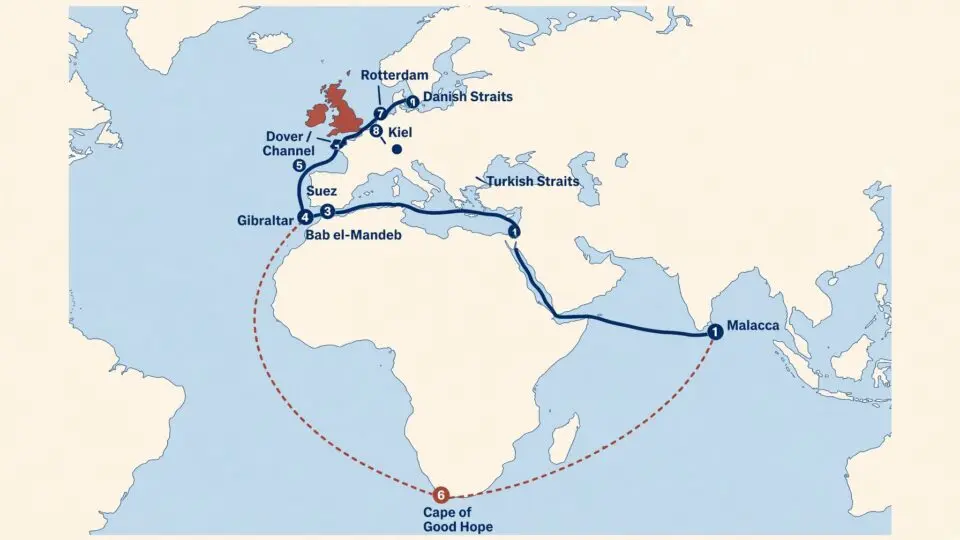
| Since 2023–24 most Asia–Europe container ships have used the Cape instead of Suez. That habit still adds about 10 to 14 days into UK ports in 2026. Air freight takes whatever cannot wait. |
Written for importers, forwarders, brokers, factories that wait on parts — and anyone who has stood at a gap on a shelf and wanted a straighter answer than “the Middle East is tense.”
| Status · Passages · UK ports · Explainers |