

Britain’s food bill is not set by the harvest. It is set by the cost of growing it and then moving it. When Hormuz tightens, red diesel and fertiliser move first. The loaf and the cooking-oil bottle follow later.
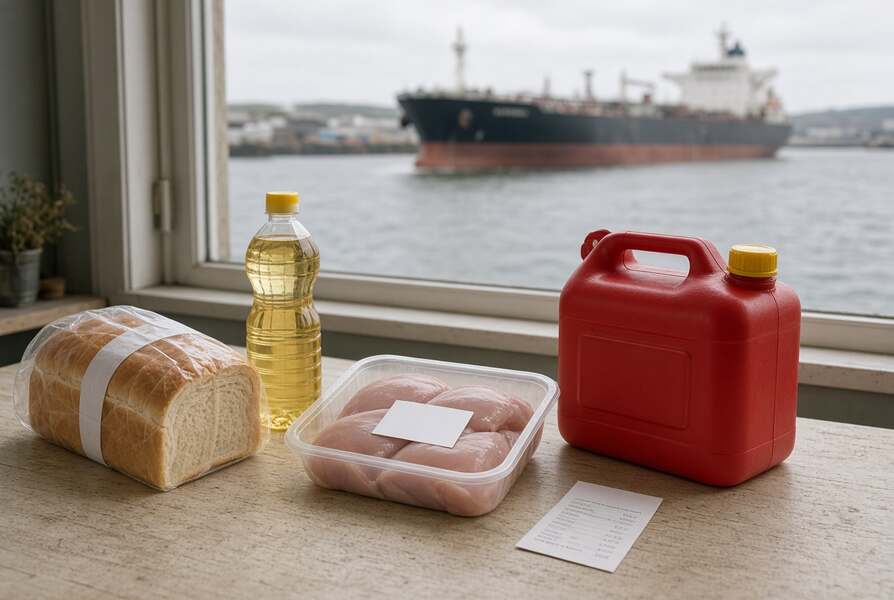
The shop does not usually empty. The prices change.
| The clock in one glance | ||
| 1–14 days Diesel and haulage |
2–8 weeks Fertiliser and cooking oil |
1–6 months Loaf and meat counter |
Why does a war thousands of miles away change my weekly shop?
The UK no longer makes enough of the two inputs under almost every meal: diesel and nitrogen fertiliser.
After Grangemouth and Lindsey closed in 2025, Britain kept four major refineries. In 2025, just under 40 percent of UK petroleum-product imports were diesel. Around 60 percent of nitrogen fertiliser is imported. About one third of global seaborne fertiliser trade normally passes Hormuz.
Where imported UK diesel came from in 2025
This is not a food-price chart. It is where Britain bought the diesel that runs tractors and supermarket lorries in 2025. The United States supplied about a third. The Netherlands and Belgium — the Amsterdam–Rotterdam–Antwerp pool — supplied most of the rest.
When Gulf crude is squeezed, that European pool tightens first. UK farm diesel and pump diesel follow. The coloured bar below is the same split in one line: US 31%, Netherlands 26%, Belgium 11%, other origins 32%.
| US 31% | Netherlands 26% | Belgium 11% | Other 32% |
Source: DUKES 2026. Netherlands and Belgium sit in the ARA hub that prices UK diesel.
Red diesel is the farm clock. Duty fell from 10.18p to 6.48p a litre on 15 June 2026. The farm price still climbed. AHDB put red diesel at 108.47p in August — 43 percent higher than August 2025. Early September farm quotes sat above 107p.
Will the shelves go empty?
Almost never. This is a price shock first, not an empty-aisle shock. Ships still arrive. Mills still run. What changes is the cost of the field and the lorry.
| Usually Same bay, higher price |
Sometimes Fewer brands or pack sizes |
Rarely from this route Empty bay — usually panic buying |
| The UK does not run out of bread. It runs out of cheap bread. Full shelves and rising labels can happen at the same time. |
Why is diesel up before bread is?
Fuel is the fast clock. Food is the slow clock. Crude can reprice the same day. UK wholesale diesel follows in sessions. The loaf waits on contracts.
| Month 2026 | Red diesel | White diesel | Clock |
|---|---|---|---|
| January–February | ~72–78p | ~145–150p | Baseline |
| March–April peak | ~110–120p | ~180–192p | Hormuz hits energy first |
| June | ~96p | 176.6p | Duty cut; crude still high |
| July | 90.7p | 164.6p | Brief easing |
| August | 108.5p | 181.5p | Second leg higher |
| Early September | ~107p | ~188–193p | Farm and pump still dear |
Sources: AHDB; DESNZ; Farmers Weekly; RAC / Fuel Finder. Figures rounded.
Red diesel, early September ~107p
White diesel, mid-September ~193p
Why is cooking oil dearer when the bread aisle still looks fine?
Two doors. Bread is wheat and energy. Cooking oil is more tightly tied to the Black Sea. Ukraine supplied about two-thirds of the UK’s crude sunflower-oil import value in 2025.
| Energy door — Hormuz Diesel, jet, heating oil, urea feedstock. Felt at Immingham and on the lorry bill. Speed: days. |
Food door — Black Sea Wheat, maize, sunflower oil, feed. Felt in Humber bulk and on the bottle. Speed: weeks, then months. |
How long after a route sticks does a UK shelf change?
| What moved | First signal | Lag to the UK | What you notice |
|---|---|---|---|
| Red diesel | Same day as crude | 1–7 days | Farm bills |
| White diesel / haulage | Wholesale rack | 1–14 days | Delivery surcharges |
| Urea / ammonium nitrate | Days after Hormuz tightens | 2–8 weeks | Next season’s crops |
| Sunflower oil | Black Sea loadings + energy | 3–6 weeks | Dearer bottle |
| Loaf and chicken | Feed and mill contracts | 1–6 months | Label price, full shelf |
The Bank of England projected food-price inflation near 3.5 percent by December 2026. The Food and Drink Federation now expects about 3.9 percent by December 2026 and a peak near 6.4 percent in July 2027. July 2026 actual food inflation was still only 1.3 percent. That is the lag.
Where food inflation is heading
July 2026 actual — 1.3%
December 2026, Bank of England — 3.5%
December 2026, FDF — 3.9%
July 2027, FDF peak — 6.4%
Sources: ONS; Bank of England MPR, July 2026; Food and Drink Federation, September 2026.
Is this the same as 2022?
No. Same plumbing. Slower pass-through so far. In 2026, supermarket competition has held more of the cost in margins. That is why food inflation could sit at 1.3 percent in July after a spring oil spike.
| 2022 Fast spread from energy into food, then into the whole inflation basket. |
2026 Lower peak, longer plateau. FDF now talks about mid-2027, not a short spike. |
The risk is not that Britain runs out of food. The risk is several gates staying tight at once — Hormuz, the Cape, the Black Sea — plus a poor European harvest. One gate changes a price. Three gates plus weather change a year.
What should I watch if prices keep rising?
| Watch first | Red diesel on the AHDB farm tracker |
| Then | Urea and imported ammonium nitrate |
| Then | Wholesale vegetable oil, not only the bottle on offer |
| Count back | April fertiliser shock → summer field cost → winter label |
Buy the usual staples when prices are calm. Do not empty a bay because a headline said “food crisis.” Britain will still have bread. It may not have cheap bread for as long as people expect. That is the passage between the tanker and the shelf.
Sources: AHDB fuel tracker, August 2026; AHDB and NFU fertiliser notes; DESNZ Quarterly Energy Prices, June 2026; CMA road-fuel monitoring; DUKES 2026; Defra AUK 2025, chapter 13; Bank of England MPR, July 2026; FDF forecast, September 2026; ONS; Farmers Weekly, September 2026.