

A photo of a bare bay travels faster than a lorry. People then type the same question: why are supermarket shelves empty in the UK?
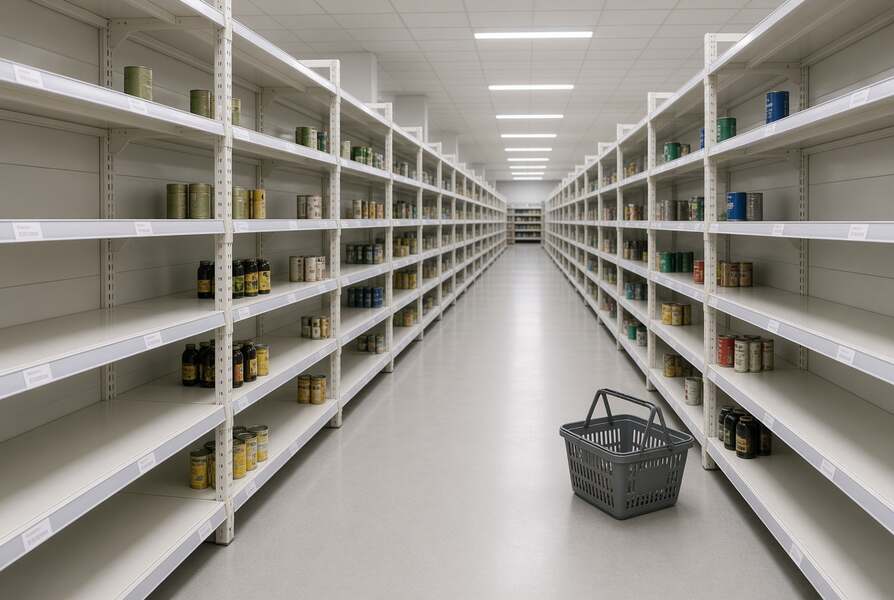
Most of the time the country is not running out of food. One store is missing one line. That is a different problem. This page is how to tell which problem you are looking at, and what to do that actually helps.
| Three empty shelves. Only one is a food-gate problem. | ||
| 1. Local gap This store, this afternoon. The depot still has it. |
2. Range cut Fewer brands or pack sizes. Core line still there. |
3. Tight commodity The same item missing in many stores for days. Oil, salad, eggs. |
Why does one Tesco look empty when the next town is full?
UK grocery works on a short chain. A big store is topped up from a regional depot several times a week. A convenience store is topped up even more often, with a smaller back room.
If the 4am trunker is late, the night fill is thin, a fridge bank is off, or a snow day blocks the last mile, that one shop can look stripped. The national warehouse can still be full. That is why a video from Stonehaven or Altrincham is not proof that Britain has run out of milk.
| What you see | Usual cause | How long it lasts |
|---|---|---|
| One bay empty, next aisle full | Missed delivery, late fill, fridge off | Hours to 2 days |
| Same own-brand line missing in three chains | Factory, pack line or harvest tight | Days to a few weeks |
| Limits of 2 or 3 per customer | Retailer slowing the queue, not hiding a famine | Until the next load lands |
| Sweets full, salad thin | Fresh has a short clock. Crisps do not. | Until the next growing region picks up |
Industry surveys in 2025–26 found something quieter than a crisis. About one in five UK grocery trips ends with at least one wanted item missing. An average shopper cannot find about 16 percent of the lines they came for. That is annoying. It is not the same as “the country has no food.”
Which missing foods are a Food and bulk problem?
Food and bulk on this desk means grain, cooking oil, animal feed and fertiliser. Those cargoes come through passages. A gap in chewing gum does not. Use this split.
| Watch these gaps Sunflower oil, own-brand cooking oil, some salad in winter, free-range eggs after bird flu, animal-feed related meat later. |
Usually not a gate One flavour of crisp, one bread brand, one fridge bank in a heatwave, one snowed-in town. |
Cooking oil is the cleanest Food and bulk example. Ukraine supplied about two-thirds of the UK’s crude sunflower-oil import value in 2025. When Black Sea loadings tighten, the bottle can go thin in weeks. Shoppers then buy rapeseed and olive oil instead, and those bays look empty too. That is substitution, not three separate famines.
Bread is the opposite lesson. In 2020 the UK still milled plenty of wheat. What ran short was the small 1.5 kg retail bag, because most flour goes to bakeries. The loaf can sit on the shelf while the home-bake bag is gone. A missing bag is not a missing harvest.
Is this a national shortage or just my store?
Ask four checks before you treat a photo as a national fact.
| Check 1 | Is the same item missing at another chain within a mile? |
| Check 2 | Is it missing online for home delivery to the same postcode? |
| Check 3 | Has it been missing for more than 48 hours, not just this visit? |
| Check 4 | Are several stores now limiting that line to 2 or 3 per customer? |
Zero or one “yes”: local. Two “yes”: tight in that region. Three or four “yes”: the commodity is tight. That is when a passage — Black Sea oil, Spanish salad weather, bird flu, a closed pack-house — is doing real work.
How a gap usually arrives
| Gate or weather | Factory / pack | Depot | Your bay |
Most photos are taken at the last box. The cause often sat two boxes earlier.
Why do shops put “temporarily out of stock” signs up?
Because an empty fixture looks worse than a sign. Retailers also pull remaining packs to the front, drop a whole fixture, or keep the premium line and drop the cheap own-brand. That can look like a shortage when it is a buying choice: protect the lines most people need, cut the rest.
Limits of two or three bottles are the same idea. They stop the first twenty trolleys taking the week’s oil. They are not a government ration book.
What should I do if my usual item is missing?
Helpful moves are small and dull. Unhelpful moves empty the next bay for everyone else.
| Do this | Skip this |
|---|---|
| Buy the week you need. Switch brand or pack size. | Fill the trolley “in case.” That is how a thin bay becomes an empty bay. |
| Try the other chain, then the online slot, then the corner shop. | Treat one phone video as a national shortage. |
| For oil: rapeseed if sunflower is gone. For salad: a different veg that stores well. | Strip eggs, milk and oil in one go. Those three rumours feed each other. |
Keep a normal cupboard, not a bunker. A few days of staples you already eat is household sense. A second trolley of oil because a headline used the word “crisis” is how 2020 flour bags vanished while bakeries still had flour.
Will Britain actually run out?
Not on the evidence of a single empty bay. The UK still grows a large wheat crop, still lands bulk at Immingham and the Humber, still holds mill and retailer stock, and still buys on a world market. What you should expect, if several gates stay tight at once, is not a dark shop. It is a dearer bottle, a shorter choice, and the odd limit on the line that everyone suddenly wants.
Price first. Thinner range second. Empty shelf last, and usually only after people strip the aisle.
If you came here because a photo looked frightening: check the next store, check the next day, and buy what you will cook this week. That is the useful answer to “why are supermarket shelves empty in the UK?”
Sources and context: Pricer UK shopper poll, Dec 2025 (on-shelf gaps ~16%); DHL Supply Chain / Retail Economics, Mar 2026 (one in five trips missing an item); YouGov in-store grievances; ONS Opinions and Lifestyle Survey, shortages module, 2026; Defra AUK 2025 ch.13 on oilseeds and feed; Passage Brief Black Sea and food-cost clock notes, Sep 2026; retailer statements on isolated store gaps versus national availability.